Translate

BUY NOTES

BUY NOTES
PatientCare लेबलों वाले संदेश दिखाए जा रहे हैं. सभी संदेश दिखाएं

bio medical waste management rules

 Safe disposal of biomedical waste is now a legal requirement in India. The Biomedical Waste and Handling Rules-1998, was notified by the Ministry of Environment and Forests (MoEF) under the Environment (Protection) Act, 1986.

Central Government GSR 343 (E) published on March 28, 2016, Bio-Medical Waste Management Rules, 2016.

Bio-Medical-waste-Rules


According to these rules, it is the duty of every "occupier" (a person who controls the institution or its premises) to ensure that all waste is taken to prevent any adverse effects on human health and the environment. It consists of six schedules. Which includes the following-

Schedule I:-

It defines the categories of biomedical waste.

bmw schedule I


Schedule II:-

In this, the color coding and type of the container to store the biomedical waste is described.

Biomedical waste schedule II


Schedule III: -

Bio-Medical Waste Containers / Bags Label.

Biomedical waste management schedule III


Schedule IV:-

The label to be prepared for transport is described.

year ………… Month ………… ....... day …………


Date of generation ……………… …………………………


Waste category No …… ..


Waste class


Waste description


Send used Name & Address Receiver’s Name & Address


Telex No… ..........…… Telex No …………………


Phone No… ................... Phone No …… .......... ………


Contact Person …… …………………………………………. ..... Contact Person ………

Fax No …………… ....... Fax No ……… ……… …… ..


In case of emergency please contact Name & Address:


Phone no.


Note: Label shall be non-washable and prominently visible.

Schedule V:-

Schedule for Waste Treatment Facilities like Incinerator / Autoclave / Microwave System.10 (Source- The Bio Medical Waste (Management and Handling) Rules, 1998).

Schedule VI:-

Standards for Treatment and Disposal of Bio-Medical Wastes Standards For Incinerators

biomedical waste management in hospital

biomedical waste management in hospital

Medical care is important for our life and health, but the waste generated by medical activities represents a real problem of living nature and the human world. Improper management of waste generated in health care facilities has a direct health impact on the community, health care workers, and the environment. Every day, relatively infectious and hazardous wastes are generated in healthcare hospitals and facilities around the world. Indiscriminate disposal of hospital waste and exposure to such waste poses a serious threat to the environment and human health that requires specific treatment and management before final disposal.

biomedical waste management in hospital


Defination

According to the Biomedical Waste (Management and Handling) Rules, 1998 of India, "any waste generated during the diagnosis, treatment or vaccination of humans or animals or related to research activities or in biological production or testing."

Sources of BMW

The hospital is the main source of biomedical waste production and its quantity and type is increasing every year. These biomedical wastes, in addition to the risk to patients and personnel, are also a threat to public health and the environment.

  • Blood banks/mortuaries/autopsy centers.
  • Production units.
  • Biotechnology institutions.
  • Medical colleges and research centers/ paramedic services.
  • Govt. hospitals/private hospitals/nursing homes/ dispensaries.
  • Veterinary colleges and animal research centers.
  • Primary health centers.

Objectives

  • Infection control
  • Prevention from the hazards caused by harmful and hazardous waste.
  • Prevention of hazards arising during waste handling at any stage.
  • Preventing climate and land pollution due to lack of proper management of the waste.
  • Preventing the use of the remaining medicines and paraphernalia.

Classification of Bio-Medical Waste

The World Health Organization (WHO) has classified medical waste into eight categories:
  • General waste
  • Pathological
  • Radioactive
  • Chemical
  • Infectious to potentially infectious waste
  • Sharps
  • Pharmaceuticals
  • Pressurized containers

Process of Biomedical waste management

BMW is done under a process that has a fixed protocol.

Waste collection and Segregation

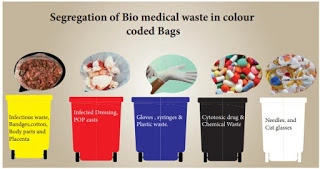
This process is done at the place where the waste originates, such as collecting the waste generated in the hospital or laboratory at the same place. This biomedical waste is of two types, which is divided into Hazardous and Non Hazardous. It is separated according to nature. For this, there are different colored containers or polythene in the hospital, whose coding is different, according to which garbage is put in them.
Black color
Non infectious waste such as paper, tissue paper, kitchen waste, medicine covers etc. fall into this category.
Yellow color
In this, infected waste is kept like- Human organ, Tissue, body parts, dressing waste, pus etc.
Red color
In this infected plastic vest like gloves, catheter, IV set, bottle, blade and urine bag are kept.
Blue color
The broken glass bottle is collected in it.

Storage and Transportation

Biomedical wastes are stored in polythene as per color coding and brought to the central storage to store. It is kept until this biomedical waste is collected in sufficient quantity. Then it is sent to the disposal site for disposal by proper means of transport.

Treatment and disposal

There are several methods of disposal of biomedical waste which depend on its type. These methods are-
Incineration
It is a high temperature thermal process that converts waste materials into inert materials and gases by combustion. This can be from an oil or electrically operated machine or a combination thereof.There are broadly three types of incinerators used for hospital waste: hearth type, rotary kiln and controlled air type. All types may have primary and secondary combustion chambers to ensure maximum combustion.
Chemical method
Blue and red color bag vests such as plastic bags, catheters, gloves etc. are immersed in the disinfectant solution before disposal. For this, 1% hypochloric acid can be used.
Microwaves irradiation
In this method, high frequency microwaves are applied to the infected waste which destroys microorganisms.
Autoclaving
It works on the principle of simple pressure cooker. It is used to sterilize steam at high temperatures. It destroys the micro-organism. It has disinfected things made of heavy metal.
Plasma pyrolasis
Plasma pyrolysis is a state-of-the-art technique for the safe disposal of medical waste. It is an environmentally friendly technology that converts organic waste into commercially useful by-products. The high heat generated by plasma enables it to dispose of all types of waste, including municipal solid waste, biomedical waste and hazardous waste in a safe and reliable manner. Medical waste in CO, H2 and hydrocarbons is destroyed when exposed to plasma arcs. These gases are ignited and a high temperature (about 1200 ℃) is produced.

PCPNDT ACT

PCPNDT ACT

The sex ratio in India dropped very fast. This was 972 in 1901, which came down to 927 when it was decreasing. To prevent this, the Pre-conception and Pre-natal Diagnostic Techniques Act-1994 PCPNDT Act, 1994 was enacted in 1994. The main purpose of implementing this Act is to ban the use of sex selection techniques before or after conception and to prevent the misuse of prenatal diagnostic technique for sex selective abortion.

PCPNDT ACT


Under this Act, conducting or helping to conduct prenatal diagnostic technique in Unregistered units, PND test for any purpose other than as mentioned in the Act, sex selection on a man or woman. , Sale, distribution, supply, rental of any ultra sound machine or any other device capable of detecting the sex of the fetus is an offense under the Act.

Provisions

  • The Act provides for a ban on gender selection before or after conception.
  • It controls the use of pre natal diagnostic techniques, such as ultrasound and amniocentesis. This allows them to use them to detect only a few cases.
  • No laboratory or center or clinic shall conduct any test, including ultrasonography, for the purpose of determining the sex of the fetus.
  • A person, who is conducting the procedure in accordance with the law, will not tell the pregnant woman or her relatives about the sex of the fetus by words, signs or any other method.
  • Any person who advertises for prenatal and pre-conception sex determination facilities in the form of a notice, circular, label, wrapper or any document, or in an electronic or print form through internal or other media May be done through hoarding, wall painting, signal, light, sound, smoke or gas for up to three years of imprisonment and a fine of Rs 10,000.
  • The Act mandates compulsory registration of all diagnostic laboratories, all genetic counseling centers, genetic laboratories, genetic clinics and ultrasound clinics.

Amendments

  • The Pre-Natal Diagnostic Techniques (Regulation and Prevention of Misuse) Act, 1994 (PNDT), 2003 amended the Pre-Conception and Pre-Natal Diagnostic Techniques (Prohibition of Sex Selection) Act (PCPNDT Act) so that sex selection Regulation of the technique used could be improved.
  • The Act was amended to bring the technology of pre-conception sex selection and ultrasound techniques within the purview of the Act.
  • The amendment also empowered the central supervisory board and a state-level supervisory board was formed.

preparation of the patient for MRI scan

The MRI SCAN does not require some special preparations, but still under certain circumstances the patient cannot be scanned in the strong magnetic field of the MRI. Before the scan, the staff and technologist should be informed about the following things from the patient. On the basis of these, radiology technologists or radiologists can find out whether an MRI scan can be done and whether the scan needs to be modified for the particular condition of the patient.

preparation of the patient for MRI scan


MRI SCAN can be contracted under the following circumstances.

  • Pacemaker- If the patient has pacemaker, then his MRI is not SCAN.
  • Pregnancy- In this case the strong magnetic field of MRI can affect the child.
  • Claustrophobia- In this case the patient may need to be sedated, so it is necessary to have an attendant with the patient.
  • History of kidney problems
  • Skin tattoos
  • Neurostimulators (TENS-unit)
  • Implanted drug infusion device (i.e., insulin pump)
  • Exposure of metal fragments to your eye
  • Artificial heart valves
  • Aneurysm clips
  • Cochlear implants
  • Metallic implants and prosthesis
  • Vascular stent or stent graft
  • History as a metal worker
  • Shrapnel or bullet wounds
  • Dorsal column stimulators
  • Allergy to iodine, or gadolinium
  • History of diabetes
  • Other conditions you believe to be relevant
  • MRI Contrast agent- No definite contraception is known for this, yet in all conditions of the iodinated contrast agent, they are contraindicated.

During the MRI scan, the patient is given a fresh hospital gown. Physical jewelry, goggles, wristwatches etc. are taken out of the patient.

Credit card and other magnetic stripe items deteriorate in the strong magnetic field of MRI, they are also kept out of the MRI room. Brain / head disease scans should not have makeup as some brands contain metals.

sterlization techniques in operation theatre

Sterlization is the process by which an object is freed from micro-organism. Sterlizaton is the process that eliminates, remove, kill or deactivate all forms of life from a particular surface, object or fluid such as food or biological culture media.

sterlization techniques in operation theatre


OBJECTIVES

  1. Providing infection-free supply / article
  2. Doing complete destruction of micro organism.
  3. Sterlize the instruments and equipment used in surgical practice.
  4. Keep the article ready in ready to use condition so that they can be used at any time.
  5. For safety from infection of the patient.

METHODS OF STERLIZATION

NATURAL METHOD OF STERLIZATION

This method is used for contaminated linen and bedpans. Direct sunlight can kill acid-fast bacteria. For this, linen and badpans are kept in direct sunlight for 6 hours for two consecutive days.

PHYSICAL METHOD OF STERLIZATION

All types of bacteria can be killed in this method. Heat is the most common used and safest agent for sterlization in hospitals. The heat for sterlization can be used as follows.

Boiling (Moist Method)

Keeping an instrument or article in boiling water (100 ℃) for 10 minutes can kill most of the pathogens present. For this, the article surface should be very clean, and the article should be completely immersed in water.

The lid of the sterlizer should be tightly closed. The article is kept closed in a sterlizer for 7 to 10 minutes. After sterlization, the article is removed from the sterlizer by chittle foreceps.

The article should not remove the sterlizer in the middle of the boiling process. Sharp instruments such as scissors, knives, needles etc. should not be boiled as they can become blunt due to boiling.

ADVANTAGE

Boiling can be used in the home environment.

It is an economic method of sterlization.

DISADVANTAGE

Some bacteria and viruses and all types of spores are not killed by boiling, meaning they are heat resistent.

This process cannot be used for articles that are destroyed by moisture and heat.

AUTOCLAVING

Autoclaving is the most commonly used method for sterlization of surgical instruments. It is the best, safe and effective method for sterlization. This spore forming can destroy micro-organism.

In autoclaving, sterlization is performed by steam at high pressure. In autoclaving water is boiled and sterlization is carried out with the help of its steam.

When the pressure increases in a closed vessel, its temperature also increases. When this steam comes in contact with a cooler surface, its condensation converts it into water and gives this surface this steam latent heat, which has a temperature of 121 ℃. For this, the article is kept in autoclave for 15-45 minutes. In this, surgical instruments, syrings tatha needles, linen, masks, abdominal swabs and dressing etc. can be sterlized.

HOT AIR OVEN

In this process, sterlization is done by hot air at 160 ℃. It can sterlize glassware, forceps, scissors, scalpels, syringes, liquid parafins and dusting powder. All types of spores, micro-organisms can be destroyed by this method. This is a safe but costly method of sterlization. The glassware is dried before placing in it.

CHEMICAL METHOD OF STERLIZATION

This is called cold sterlization or disinfection by disinfectants method. In this, the chemical disinfectant is used which either coagulation of bacterial protein or change the chemical composition of the protein. Phenol, Lysol, Formalin, Dettol or alcohol are commonly used disinfectants.

This method is used to sterlize the instruments which may be damaged by heat or their corrosion may occur. Sopre cannot be destroyed by this, and it can cause injury to the skin and articles. The disinfectants are kept in correct strength. The article is fully submerged in it.

RADIATION METHOD OF STERLIZATION

In this, non-ionizing and ionizing radiation are used for sterlization. Infra red, ultra violet radiation is used as non-ionizing radiation, and x-rays and gamma-rays are used as ionizing radiaiton. By this diposable syringe, catheters, sharp instruments which cannot bear heat are sterlized.

GAS STERLIZATION

For this ethylene oxide (oxirane) gas is used for sterlization. Its special chambers are made, whose temperature and humidity are controlled. Before sterlization it is removed from the air and the articles are kept in these chambers for 3 to 6 hours. Gases like formaldehyde and betapropiolatone etc. are also used for sterlization.

eLORA ( e-Licensing of Radiation Applications )

The use of ionizing radiation techniques in the fields of medicine, industry and basic research has increased in the last decade in India. These uses are generating huge social benefits in terms of cancer treatment, diagnosis and industrial uses such as non-destructive testing and food processing applications. However, ionic radiation has some radiological hazards associated with dealing with radiation sources. If they are not handled safely, there are likely to be some radiological hazards in which serious injury or enviromental contamination are the main ones. Therefore, radioactive sources and radiaiton generators need to be safely controlled throughout their life cycle to prevent any undue risk to health and the environment. In view of the above, radiation facilities need to be regulated to ensure that the use of ionized radiation does not pose an undue risk to health and the environment.

eLORA ( e-Licensing of Radiation Applications )


The use of ionizing radiation in India is carried out by the Radiological Safety Review and Regulation of such facilities by the Atomic Energy Regulatory Board- AERB. It is a statutory requirement to obtain the requisite license from the AERB, which is issued after the Atomic Energy (Radiation Protection) Rules, 2004 issued under Atomic Energy Act 1962 to ensure overall safety of the use of radiation sources.

The growth in the application of ionizing radiation technology poses a tremendous challenge to AERB to regulate all of these facilities, effectively and efficiently ensuring the safety and security of radiation facilities with the limited resources available to AERB. To meet this challenge, AERB has taken the initiative to implement the e-governance system, eLORA (e-licensing of radiation application) for automation of regulatory processes associated with the use of ionizing radiation in India.

eLORA is a web-based I & CT (information and communication technology) application that establishes a direct communication channel between AERB and its stakeholders. It is meant to deliver its regulatory services for the exchange of information and communication transactions, as well as to achieve high efficiency, reliability and transparency in practice. The eLORA System is designed to automate the extensive business processes of the use of ionizing radiation as well as the large number of radiological application regulations targeted to include radiation workers working with them for safe service. The components of eLORA are chosen to achieve business solutions with security, performance, availability, scalability, manageability, and maintenance. The eLORA system infrastructure is based on virtualization technology, which has helped achieve cost effectiveness at the investment level during operations in a data center.